

3 mm
Up to 2.5 kg
Small cakes, single-tier cakes, number cakes, entremets and other lightweight cakes.
ExploreFor cake designers.

Cake boxes
From tall cakes to the smallest sweet details.
Shop all cake boxes
Cake structures
Explore the supports behind your next creation.
Shop all cake structures


The world of Dasbi
Meet the people, ideas and values behind every creation.

Cake board guide
The essential guide to choosing the right thickness, size, shape and finish for your cake’s weight, dimensions and number of tiers.
Shop cake boards
01
The right thickness depends on the cake’s weight, dimensions, shape, number of tiers and load distribution. Compare our 3, 6 and 9 mm cake boards to find the most suitable support for your design.
Weight recommendations are indicative. A long cake, uneven load distribution or demanding transport conditions may require a thicker cake board.
Up to 2.5 kg
Small cakes, single-tier cakes, number cakes, entremets and other lightweight cakes.
Explore
Up to approximately 10 kg
Medium-sized cakes, birthday cakes and selected two-tier cakes with an appropriate internal support structure.
Explore
More than 10 kg
Large wedding cakes, long cakes and multi-tier structures that require greater stability.
Explore3 mm cake boards are recommended for cakes up to 2.5 kg; 6 mm cake boards for cakes up to approximately 10 kg; and 9 mm cake boards for cakes over 10 kg. These are approximate guidelines: also consider the size, length, weight distribution, internal structure and transport method.
Cake board thickness does not replace an appropriate internal support structure between tiers. Very large or long cakes, or cakes with uneven weight distribution, may need a stronger board even when the total weight falls within the stated guideline.
View all cake boards02
As a general rule, the cake board should be approximately 5 cm larger than the cake overall. For a round cake, this leaves about 2.5 cm visible around the entire edge.
For example, for a cake with a 20 cm diameter, we would normally recommend a 25 cm cake board.
For square and rectangular cake boards, add approximately 5 cm to both the width and length. Large decorations, flowers, lettering, logo engraving or asymmetrical arrangements may require a wider margin.
+ 5 cm
Total cake board size: approximately 5 cm larger than the cake
Visible margin: approximately 2.5 cm on each side
| Cake size | Cake board size |
|---|---|
| 15 cm | 20 cm |
| 20 cm | 25 cm |
| 25 cm | 30 cm |
| 30 cm | 35 cm |
| 35 cm | 40 cm |
| 40 cm | 45 cm |
For other dimensions, apply the same rule: add approximately 5 cm to the cake’s overall measurement. If the design needs more decorative space, choose the next available size.
03
Select the shape that best supports the cake and complements its presentation.
Round cake boards suit circular cakes and classic designs. Square cake boards provide more defined lines and extra space at the corners. Rectangular cake boards are especially suitable for long cakes, number cakes, oval cakes and elongated arrangements.
04
Depending on the selected cake board, choose a natural, white or black edge to complete the presentation.

Warm, kraft-coloured MDF edge.

Clean, uniform white finish.

Defined, contemporary black finish.
05
Every Dasbi cake board can be personalised with your logo for a professional, consistent brand presentation. The logo is engraved directly onto the board.
For a clear, defined result, we recommend a simple design with sufficiently thick lines and an approximate height of 2.5 cm.


A cliché is the engraving-file preparation required the first time we use a new logo. Dasbi keeps it for future orders, so you will not need to request it again unless the logo changes.
MDF with a coating suitable for food contact.
Material from responsibly managed sources.
Manufactured and finished by Dasbi.
06
Compare the Dasbi MDF cake board with a traditional cardboard cake drum.
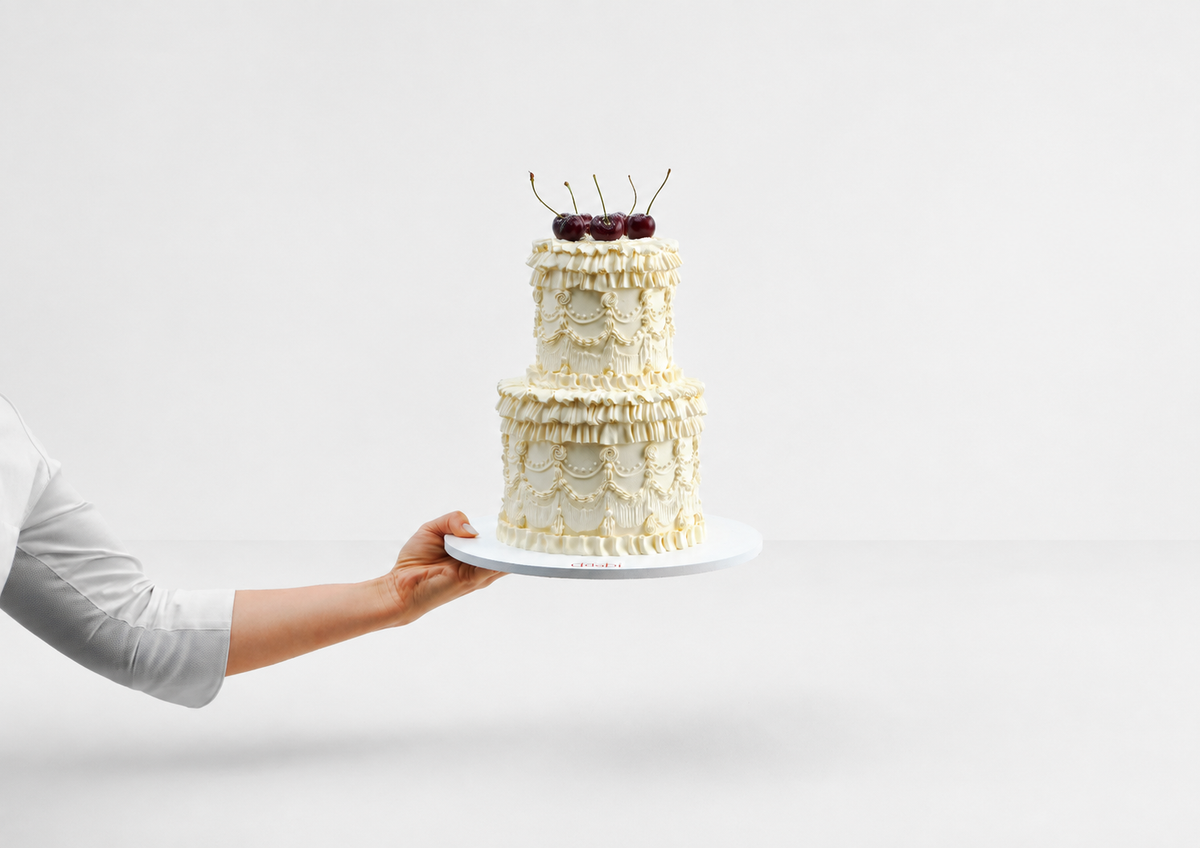

For large wedding cakes, long cakes and multi-tier structures, we generally recommend a 9 mm cake board.
Clean the surface with a soft, slightly damp cloth.

Do not immerse the cake board in water.

Do not wash it under running water.

Do not place it in a dishwasher.

Do not use alcohol, abrasive products or abrasive sponges.

Dry the surface immediately after cleaning.
Prolonged exposure to water or excessive moisture may damage the MDF.
Measure the finished cake, including its decoration. For the bottom presentation board, a diameter about 5 cm larger than the cake is a useful starting point; allow more space for flowers, lettering or your logo. An intermediate tier board normally matches the tier it supports.
Choose the box by the board’s full width and depth, not just the cake diameter. Check the stated usable dimensions and the fit of any reducer. Allow space above the finished cake, including board thickness and toppers. A matching box-and-board pack simplifies the choice, but you must still check cake weight and height.
Box and board packsChoose the bottom board by the cake’s total weight, dimensions and structure. Dasbi 6 mm and 9 mm boards provide options for more demanding designs. Each upper tier needs its own suitable board and supports. Centre-hole boards work with a compatible central dowel; a box or central dowel alone does not bear every tier’s weight.
For a conventionally stacked tiered cake, use a suitable board under each tier and supports in the tier below. Match intermediate boards to the cake diameter and align any centre holes with the central dowel. The central dowel helps alignment; it does not replace the supports carrying the upper tiers.
Cake structuresAs a guide, Dasbi recommends 3 mm for lighter, single-tier cakes up to about 2.5 kg; 6 mm for greater rigidity, up to around 10 kg; and 9 mm for larger, heavier or multi-tier designs. These are approximate recommendations: size, weight distribution, handling and internal supports also matter.
Centre the cake on a clean, suitable food-contact surface and use a small amount of icing or another edible fixing appropriate to your recipe. Let it set as needed. This helps hold the cake in position, but does not replace the boards, dowels and tier supports needed for a stacked cake.
Dasbi wooden cake boards are made from MDF, a wood-fibre composite, with a varnished surface intended for food contact under the declared conditions of use. The range also includes acrylic centre-hole boards. Check the material of your selected product; an MDF board is different from a cardboard cake card or drum.
Explore cake boardsA cake board is the support underneath a cake for handling, presentation and transport. Choose its size and thickness for the finished cake. It also helps move the cake into a box without touching the decoration. For tiered cakes, use the appropriate boards and supports throughout the structure.
Explore cake boardsSet the final board on a stable, level surface. If the cake is already on a suitable thin support, move that support onto the presentation board. Otherwise, use cake lifters suitable for its size and weight, supporting it evenly. Avoid lifting by the icing; assemble very delicate cakes on their final board where possible.
Dasbi MDF cake boards covered by the technical sheet are single-use products, so cleaning after use is not preparation for reuse. Before first use, wipe the varnished surface with a lightly damp cloth and let it dry. Do not soak it, put it in a dishwasher or use alcohol or abrasive cleaners.
Quality and careThe Dasbi MDF cake boards covered by the technical sheet are intended for one use. Do not reuse a board that has been in contact with food, is damp, damaged or has a compromised coating. For other materials, such as acrylic, follow the care instructions for that specific product.
Quality and careA cake board is the general term for a support under a cake. A cake card is usually a thin cardboard support; a cake drum is usually a thicker, covered cardboard support. Dasbi MDF boards use a wood-fibre core. Material, dimensions and construction matter more than the name alone when choosing support.
Explore cake boardsThe varnished surface of the Dasbi MDF boards covered by the declaration is suitable for direct food contact within the stated conditions, so it does not need covering for that purpose. Keep food away from engraved areas and the uncoated underside. Decorative coverings and liners must themselves be suitable for food contact.
Quality and careChoose a ready-made Dasbi centre-hole cake board that matches the central dowel and tier dimensions. This avoids drilling a coated board, which can expose its core and damage the finish. Check the hole and dowel fit before assembling, and use the supports required for each tier.
Cake structuresPlace a clean, dry non-slip mat between the turntable and the underside of the board, away from direct food contact. Check that the board sits flat and centred before decorating. Do not rely on this grip for transport or as a substitute for the supports inside a tiered cake.
Allow space around the cake for edible decoration, lettering or the presentation of your logo. Use food-contact-suitable materials and keep non-edible decorations away from the cake or properly isolated. Dasbi logo personalisation is available on selected boards; position the cake so engraved areas remain clear of food.
Explore cake boards09
Quick answers
We would normally recommend a 25 cm cake board. This provides approximately 2.5 cm of visible margin around the entire cake.
No. The recommendation means approximately 5 cm extra overall. For a round cake, this leaves about 2.5 cm visible on each side.
Yes, for selected two-tier cakes up to approximately 10 kg, provided they have an appropriate internal support structure. For larger, heavier or unevenly loaded cakes, we recommend a 9 mm board.
We generally recommend a 9 mm rectangular cake board, especially when the cake is long or heavy. Length and load distribution are as important as the total weight.
For large or multi-tier wedding cakes, we normally recommend a 9 mm cake board. The final choice should also consider weight, diameter, internal structure and transport conditions.
10
Professional guidance
Tell us the shape, dimensions, approximate weight and number of tiers. We will help you identify the most suitable option.

11
Dasbi cake boards are compatible with our cake boxes and help ensure a consistent presentation and safe transport. Check that the box’s internal dimensions suit the board’s external dimensions and that the internal height is sufficient for the cake and its decorations.
Discover cake boxes
LEADER grant · 2026
Business improvement through the acquisition of machinery
An initiative under the CAP Strategic Plan 2023–2027, co-financed by:


LEADER grant · 2022
Business improvement through the acquisition of machinery


